

 Savix
About Savix RFP Software
Evidence-led answer drafting for proposal and security teams, with supporting source excerpts placed alongside claims for review.
Teams that want source inspection to be part of each approval, rather than a separate last-minute task.
Confirm connector depth, identity requirements and supporting security documents for your proposed plan.
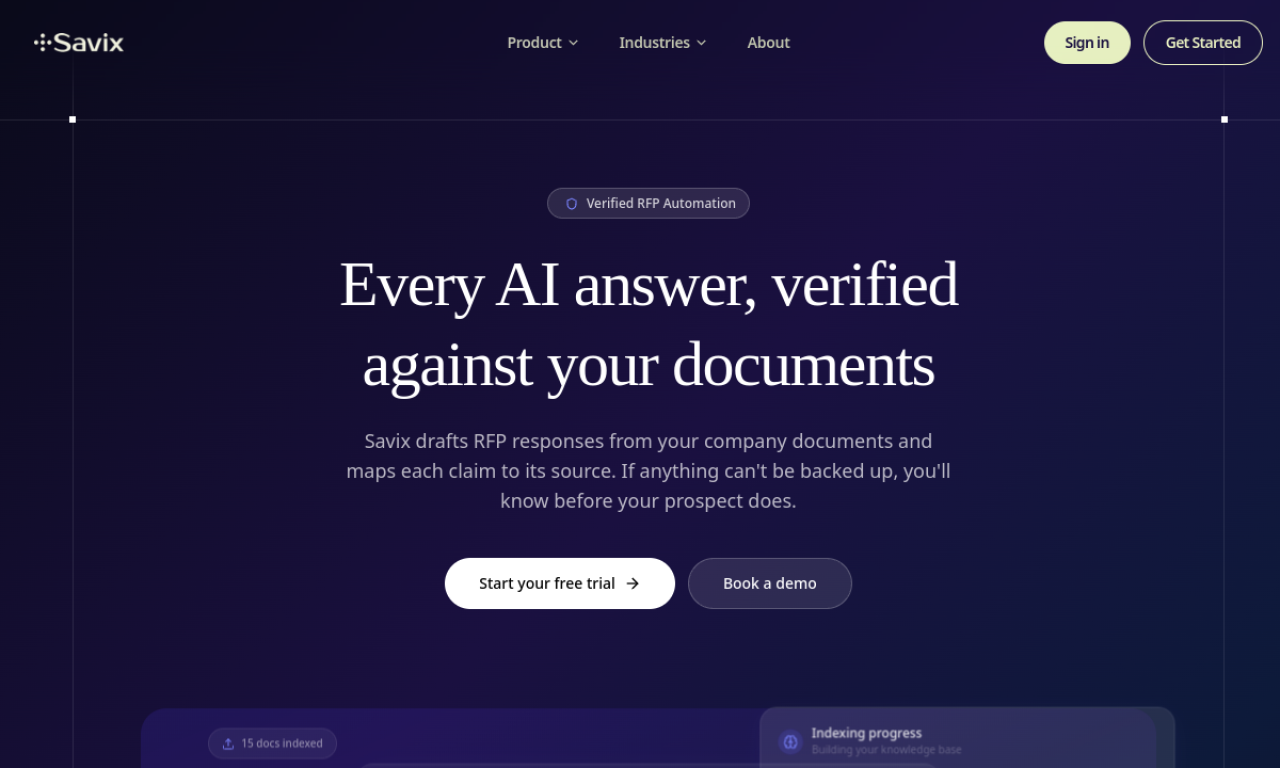
AI RFP drafting with claim-level evidence review
Create an evidence decision before approving the answer. Put a partially supported statement next to its source excerpt, ask the reviewer to narrow it, and retain both versions in the register. This tests the handoff from generated wording to an accountable approval.
A representative pilot
Keep three artifacts: the exact source passage, the specialist’s correction and the submitted answer. Include an obsolete policy so the reviewer must decide which version governs. Do not accept a citation alone as proof that every part of the claim is supported.
Record each claim, source and decision in the evidence review register. Budget the proposed configuration and internal review effort.
Pricing plans
Starter: $99/seat/month; Team: $299/month (up to 10 members)
Trial available; duration and payment requirements at signup
Price and trial terms below come from the shared product snapshot. Confirm the order form’s billing period, seats, response allowances, add-ons and renewal conditions. A public starting amount is not a complete quote for every team.
Starter
$99/seat/monthConfirm licensed users, usage and included services in the written proposal.
Visit SavixTeam
$299/monthConfirm licensed users, usage and included services in the written proposal.
Visit Savix| Scope to verify | Questions for the proposal |
|---|---|
| Team access | Which authors, reviewers and external contributors need paid licenses? |
| Response allowance | How are projects, questions and agent usage counted? |
| Knowledge sources | Which connectors and source-refresh controls are included? |
| Review and export | Which approval, audit and document-format features are included? |
| Commercial term | Confirm onboarding, billing, renewal, cancellation and export rights. |
Customer support
Support quality matters when a submission is due and a source connection, permission or export has failed. We have not independently measured response times or service quality for this product. Ask the vendor to describe the support available under your quoted plan.
- Onboarding. Identify who helps import existing answers and establish the first source library.
- Reviewer training. Ask how occasional specialists learn evidence inspection and approval without becoming system administrators.
- Issue escalation. Demonstrate how a blocked import or export is reported and which team owns resolution.
- Service hours. Confirm the hours, channels and contractual response targets applicable to your organization.
| Evaluation area | Current status |
|---|---|
| Deployment | Web-based workflow; confirm browser and hosting requirements |
| Support service | Confirm in the proposed contract |
| Training | Ask for onboarding and specialist-reviewer training scope |
| Trial | Trial available; duration and payment requirements at signup |
Security features
Product documentation is a starting point for security evaluation. Request the current evidence applicable to your proposed configuration and legal entity. Missing public detail remains an open question, not a finding that a control is absent.
Document security
- Test whether source visibility follows the reviewer’s permissions and whether restricted reports can remain separate from submitted answers.
- Inspect whether the output includes confidential source excerpts or unintended attachments. Approve the exact final document before sending it.
- Confirm deletion and retention behavior for uploaded documents, generated answers, backups and exported artifacts.
Access security
Validate authentication, reviewer roles, administrative rights and the permission scope of each knowledge connection. Use a restricted test account; an administrator demonstration cannot establish what an occasional specialist can see.
Security reports and certifications
Ask for current reports or certificates, their scope, covered entity and relevant exceptions. Distinguish the application vendor’s evidence from its infrastructure provider’s certification. Confirm model-training, subprocessors and international processing terms in the contract rather than inferring them from a badge.
User management features
The important question is whether the team can preserve accountability as work is reassigned. A response owner should know which specialist owns the answer, whether it is approved and what changed after approval. Validate the actual workflow rather than assuming all collaboration tools have the same controls.
- Define separate author, specialist reviewer and final approver responsibilities.
- Check the handling of reassignment, absence and reopened questions.
- Restrict access to evidence that is unrelated to a contributor’s section.
- Confirm what approval and access history can be retained or exported.
Document management features
Evidence-led answer drafting for proposal and security teams, with supporting source excerpts placed alongside claims for review.
The following capability names are recorded as vendor descriptions. They are not an independently measured performance result.
- Source citations — Maps generated claims to source-document quotes and displays the supporting excerpt and document reference.
- Quality audit — Classifies claims as supported, partially supported, unsupported, or rescued and routes exceptions for review.
- AI response drafting — Generates RFP and questionnaire drafts from uploaded customer documents.
- Response rewriting — Shortens, expands, rephrases, or formalizes draft answers.
- Centralized content library — Organizes uploaded proposal, policy, compliance, and technical documents for reuse.
- Document ingestion — Extracts questions from PDF, Word, and spreadsheet RFP documents.
- Semantic search — Supports natural-language questions and cited answers across the uploaded knowledge base.
- Document automation — Exports completed work to Word, PDF, or spreadsheet formats.
Use your own spreadsheet, narrative document and portal request to test these capabilities. Include mandatory fields, tables, character limits and attachments. Compare the export with the customer’s original instructions and record the repair effort.
Additional features
Reporting
Ask how draft changes, owner assignments, evidence references and final approvals are recorded. A project-complete indicator should not replace a record of the exact answer approved for submission. Determine whether history remains available after source updates and project closure.
Customization
Validate tone, terminology and output formatting with the customer’s instructions. Confirm whether reusable text can be constrained to a product, region, entity or period. Customer-specific commitments should not silently become globally approved knowledge.
Questions, collaboration and review
Include a partially supported statement and ask the reviewer to narrow it to what the cited document actually says.
For each unresolved question, identify a responsible person and an explicit next action. Keep the missing information visible through review. A generated answer must not turn an unknown capability into an unapproved promise.
Features Checklist
- Source visibility Verify in pilot
- Restricted attachment approval Verify in pilot
- Final-export inspection Verify in pilot
- Retention and deletion terms Verify in pilot
- Named reviewer roles Verify in pilot
- Permission inheritance Verify in pilot
- Identity controls Verify in pilot
- Account removal Verify in pilot
- Question navigation Verify in pilot
- Evidence inspection Verify in pilot
- In-place corrections Verify in pilot
- Clear unresolved states Verify in pilot
- Keyboard operation Verify in pilot
- Readable export Verify in pilot
- Occasional reviewer workflow Verify in pilot
- Supported browser Verify in pilot
- Source version Verify in pilot
- Answer owner Verify in pilot
- Approval history Verify in pilot
- Submission record Verify in pilot
This is a buyer’s evaluation checklist, not a claim that every listed control is present in the product. Validate each item with current evidence and the proposed plan.
Documented workflow coverage
Source traceability 2/2
Answers linked to sources: documented; Supporting source passage shown: documented.
Maps generated claims to source-document quotes and displays the supporting excerpt and document reference.
Exception review 2/2
Answer quality or evidence checks: documented; Explicit claim-level evidence states: documented.
Classifies claims as supported, partially supported, unsupported, or rescued and routes exceptions for review.
Drafting & refinement 2/2
AI response drafting: documented; Rewriting or style adaptation: documented.
Generates RFP and questionnaire drafts from uploaded customer documents. Shortens, expands, rephrases, or formalizes draft answers.
Document workflow 2/2
Buyer-file or portal processing: documented; Completed file or in-place response output: documented.
Extracts questions from PDF, Word, and spreadsheet RFP documents. Exports completed work to Word, PDF, or spreadsheet formats.
Sources and review history
Selected-source check: . Earlier research baseline: 2026-09-07.
- www.savix.io/ — vendor claim
- www.savix.io/pricing — vendor claim
- www.savix.io/rfp-automation — vendor claim
- www.savix.io/evidence-verification — vendor claim
Official-source research, not hands-on testing. Features are vendor claims; security controls, connectors and contractual terms require validation.
Editorial structure updated 2026-11-01. Product source checks retain the dates and scope shown above. This profile reports public-source research, not hands-on testing.